

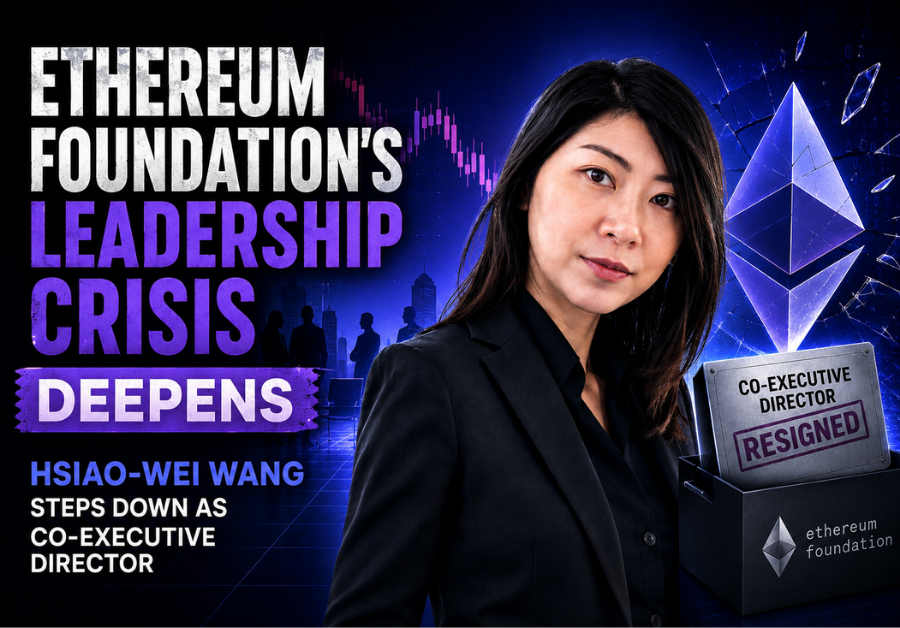
Ethereum Foundation’s Leadership Crisis Deepens: Hsiao-Wei Wang Steps Down as Co-Executive Director
The Ethereum Foundation is once again searching for direction at the top. On Thursday, June 18, co-executive director Hsiao-Wei Wang announced she is leaving the organization effective immediately, closing out a tenure that stretches back nearly a decade and adding another name to what has become one of the most turbulent leadership stretches in the Foundation’s history.
For anyone tracking the health of the Ethereum ecosystem, miners, validators, infrastructure operators, and investors alike, this isn’t just an HR footnote. It’s the latest data point in a pattern that’s been building since the start of the year, and it raises real questions about how the nonprofit steering one of crypto’s most important networks plans to steady itself.
At Mine Mirth LLC, we follow these developments closely because governance instability at the protocol level eventually ripples down to everyone building on top of it, including the mining and hosting community we serve every day. Here’s what happened, why it matters, and what it might mean going forward.
What Wang Announced – Ethereum Foundation’s Leadership
In a post shared on X, Wang said she had reached her decision after returning from a sabbatical earlier this year, a time away that gave her room to reconsider her priorities. She described the moment plainly: this felt like the right time to step back.
She didn’t frame her exit as a break from Ethereum itself, however. In her statement, Wang was careful to separate her role at the Foundation from her relationship with the broader ecosystem, describing Ethereum as something far bigger than any single organization or position. Its real strength, she said, comes from the builders, researchers, and operators who keep its permissionless infrastructure running. She added that she hasn’t fully mapped out her next chapter yet, but expects to spend more time closer to home, and that she still considers herself part of the community, whether she’s contributing from inside the Foundation or outside it.
Ethereum co-founder Vitalik Buterin publicly acknowledged her decade of work, calling her a steadfast contributor to the ecosystem.
A Career Rooted in Ethereum’s Technical Core
Wang’s departure is notable in part because of how deep her roots in Ethereum actually go. She joined the Ethereum Foundation’s research team back in 2017 as a core Layer 1 researcher, working on some of the network’s hardest technical problems, including early sharding research and consensus design. Most significantly, she was a key contributor to the design of the Beacon Chain, the backbone that made Ethereum’s move from proof-of-work to proof-of-stake possible.
That work culminated in her promotion to co-executive director in March 2025, where she served alongside Tomasz Stańczak as part of a restructured leadership model, making her the first contributor to rise from the Foundation’s technical research ranks all the way to its top leadership seat. It’s that arc, from protocol researcher to organizational lead, that makes her exit sting a little more than a typical executive departure would.
Part of a Bigger Pattern, Not an Isolated Exit
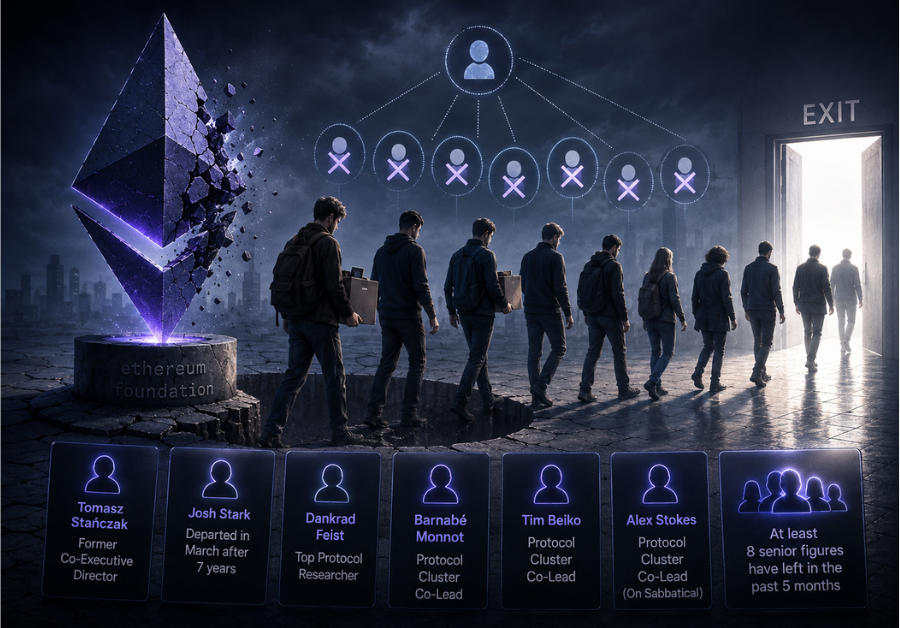
Wang’s move follows directly on the heels of Stańczak’s own resignation as co-executive director, announced earlier this year after he helped guide the Foundation through a leadership transition. With both co-EDs now gone, Bastian Aue, a Foundation board member, has stepped in to help guide the organization through the interim, a role he’d already begun taking on during Wang’s sabbatical.
But the bigger story is the sheer volume of departures stacking up. Over roughly the past five months, at least eight senior figures have left the Ethereum Foundation, including:
- Tomasz Stańczak, former co-executive director
- Josh Stark, departed in March after seven years with the organization
- Dankrad Feist, a top protocol researcher
- Barnabé Monnot and Tim Beiko, two of the three leads of the Foundation’s Protocol cluster
- Alex Stokes, the remaining Protocol cluster co-lead, who has since announced his own sabbatical
That’s a striking amount of turnover for an organization whose stability the ecosystem has historically taken for granted. It has fueled growing community scrutiny over the Foundation’s governance, internal strategy, and overall direction, scrutiny that’s only intensified given the competitive pressure Ethereum is facing from rival Layer 1 blockchains looking to capture developer mindshare and on-chain activity.
The Backdrop: A Foundation Trying to Redefine Itself
This wave of exits hasn’t happened in a vacuum. About a month before Wang’s announcement, Vitalik Buterin signaled that the Foundation itself was intentionally shifting into what he described as a “smaller ship,” a leaner team built around a narrower mission centered on censorship resistance, privacy, and security, often shorthanded within the community as CROPs.
That repositioning hasn’t been without friction. Reports surfaced that the Foundation had asked staff to sign a loyalty pledge tied to the new CROPs mandate, a move that reportedly generated real pushback internally. Some community members have read the strategic narrowing as a signal that the Foundation is stepping back from competing aggressively in the corporate and enterprise blockchain space, a debate that’s still playing out in public Ethereum forums and on social media.
Whether this restructuring is the cause of the departures, a response to them, or simply happening in parallel is genuinely difficult to untangle from the outside. What’s clear is that the Foundation is in the middle of a significant identity shift at exactly the moment it’s lost a large share of its senior leadership bench.
Why This Matters Beyond the Foundation’s Walls
It’s worth being direct about what this does and doesn’t mean. Leadership turnover at the Ethereum Foundation does not change the Ethereum protocol overnight. The network itself, its validators, and its existing roadmap continue to function independently of who sits in the Foundation’s executive seats. The Foundation is a nonprofit that supports the ecosystem’s development; it isn’t Ethereum’s central operator.
That said, execution risk is real. Governance continuity, roadmap coordination, and the Foundation’s institutional voice in conversations with regulators, exchanges, and enterprise partners all depend on stable leadership. For the people actually running Ethereum infrastructure node operators, stakers, and yes, the broader mining and validation community, the practical question isn’t whether Ethereum keeps working tomorrow. It’s whether the organization that’s supposed to coordinate research, fund public goods, and represent the ecosystem’s interests can do so effectively while it’s still figuring out who’s steering and what its mission actually looks like going forward.
Mine Mirth LLC’s Take
We’ve watched enough market cycles to know that protocol-level governance noise tends to get dismissed quickly by traders chasing the next price candle, but it deserves more attention than that. Ethereum’s transition to proof-of-stake, which Wang herself helped architect, fundamentally reshaped the role of mining hardware in the broader proof-of-work landscape, pushing renewed focus toward chains like Bitcoin where ASIC mining remains the backbone of network security.
That’s precisely where we focus our energy at Mine Mirth LLC. While the Ethereum Foundation works through its leadership transition, the proof-of-work mining economy continues to depend on reliable infrastructure, properly maintained hardware, and operators who actually understand the hosting environment. We supply and host ASIC miners and related accessories for operators who want consistent uptime without managing the technical and logistical overhead themselves, whether you’re scaling a small home setup or running fleet-level operations.
If you’re rethinking your mining strategy amid all this ecosystem turbulence, our team is glad to walk through what hosting or equipment options make sense for your situation.
The Road Ahead
For now, the Ethereum Foundation moves forward without either of the co-executive directors who were meant to lead it through this chapter, leaning on interim board leadership. At the same time, the dust from a five-month exodus continues to settle. How quickly and with whom the Foundation rebuilds its executive bench will likely shape community confidence in its governance for some time to come.
We’ll keep monitoring this story and others affecting the broader crypto infrastructure landscape. For more on Ethereum’s technical fundamentals, the Ethereum.org developer documentation remains one of the most reliable public resources available.
The Mine Mirth LLC editorial team prepared this article based on publicly available statements and reporting. Mine Mirth LLC is not affiliated with the Ethereum Foundation.



Great content! Keep up the good work!
Thank you for the appreciation!!! 😊😊😊😊