
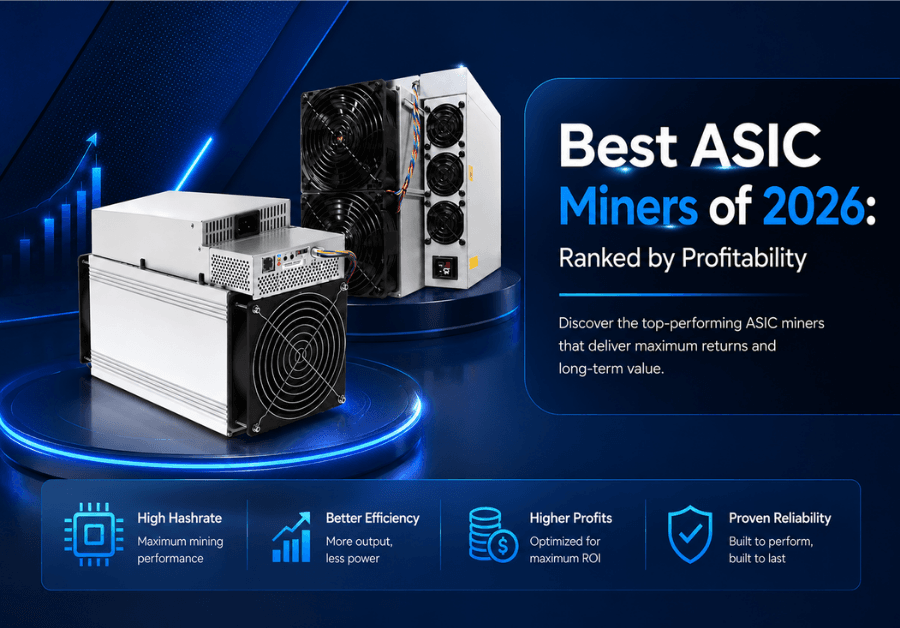
The Best ASIC Miners of 2026: Ranked by Profitability
If you are serious about Bitcoin mining in 2026, your hardware choice will make or break your profitability. With electricity costs rising and network difficulty at all-time highs, picking the wrong machine is an expensive mistake. This guide ranks the best ASIC miners available right now based on real-world profitability, efficiency, and value for money, whether you are just getting started or deciding whether to upgrade your existing rig.
We have done the research, so you do not have to. Below you will find everything you need to make a confident, informed decision, updated to reflect current market conditions as of June 3, 2026.
What Is an ASIC Miner and Why Does It Matter?
An ASIC (Application-Specific Integrated Circuit) miner is hardware built with one purpose: mining cryptocurrency. Unlike GPU rigs or CPUs that can handle multiple tasks, ASIC miners are engineered exclusively for maximum hashing performance at minimum power draw.
In 2026, ASIC miners dominate Bitcoin mining entirely. If you are planning to mine Bitcoin competitively, a high-quality ASIC is non-negotiable. The key metrics that determine whether an ASIC miner is worth buying are:
- Hashrate (TH/s): how much computational power it delivers
- Energy efficiency (J/TH): how many joules it uses per terahash
- Purchase price: upfront hardware cost
- Noise and heat output: important for home miners
- Cooling requirements: air, hydro, or immersion
You can compare live specs and profitability across hundreds of models at ASIC Miner Value, which updates data in real time.
What Affects ASIC Miner Profitability in 2026?
Before diving into the rankings, it is important to understand what drives profitability. Even the best ASIC miner in the world becomes unprofitable under the wrong conditions.
June 2026 Market Snapshot: Bitcoin is trading around $67,500 following a sharp drop on June 2, its first dip below $70,000 since April. The network hashrate sits at approximately 738 EH/s with a mining difficulty of 138.96 T. The next difficulty adjustment is projected for June 13 and is expected to decrease by roughly 9%, offering some relief to miners. Always model multiple BTC price scenarios before committing capital.
Electricity Cost: This is the single biggest variable. Miners paying above $0.07 per kWh will find profitability tight with most machines. The sweet spot remains $0.04 to $0.06 per kWh. The most efficient current machines, like the Antminer S21 XP, have a breakeven threshold near $48,000 per BTC at $0.04/kWh, well below current prices.
Bitcoin Price: Higher BTC prices mean higher mining revenue. Bitcoin hit an all-time high of $126,198 in October 2025 before entering a significant correction. It is currently trading around $67,500, down over 14% in the past 30 days. Always model your ROI at conservative, current, and optimistic price scenarios before purchasing hardware.
Network Difficulty: As more miners join the network, difficulty increases and individual earnings drop. The Bitcoin network previously crossed 1 zetahash (1,000 EH/s) in January 2026, though it has since pulled back to approximately 738 EH/s following energy disruptions. Difficulty currently stands at 138.96 T. You can monitor this in real time at CoinWarz or Minerstat.
Hardware Efficiency: More efficient machines (lower J/TH) cost less to run and remain profitable longer as difficulty rises. The efficiency gap between generations has widened dramatically; the S21 XP at 13.5 J/TH is a 37% improvement over the older S19 XP Pro at 21.5 J/TH.
Pool Fees: Most mining pools charge 1 to 2.5% of earnings. Factor this into your calculations. Reputable pool options and fee structures can be compared at Hashrate Index.
Best ASIC Miners of 2026: Our Top 5 Ranked
| Rank | Miner | Hashrate | Efficiency | Est. Price | Cooling |
|---|---|---|---|---|---|
| 1 | Antminer S21 XP | 270 TH/s | 13.5 J/TH | ~$4,081.00 | Air |
| 2 | Antminer S21 Pro | 234 TH/s | 15.0 J/TH | ~$3,600 | Air / Hydro |
| 3 | WhatsMiner M66S | 298 TH/s | 18.0 J/TH | ~$5,200 | Air / Hydro |
| 4 | Canaan Avalon A1566 | 185 TH/s | 19.5 J/TH | ~$3,100 | Air |
| 5 | WhatsMiner M53S++ | 320 TH/s | 22.0 J/TH | ~$6,000 | Immersion |
1. Bitmain Antminer S21 XP – Best Overall
The Antminer S21 XP is our top pick for 2026. At 270 TH/s and 13.5 J/TH, it is the most efficient air-cooled Bitcoin miner commercially available, a 10% improvement over the S21 Pro and a 37% improvement over older S19 XP Pro models at 21.5 J/TH. This efficiency edge matters most in the current environment, where BTC is trading around $67,500, and margins are compressed.
Bitmain’s 5nm BM1370 chip architecture is the foundation of this advantage. During the February 2026 BTC dip to $60,000, operators running S21 XP fleets continued generating profit while S19-class machines struggled to break even. The breakeven threshold sits near $48,000 per BTC at $0.04/kWh.
For hydro-cooled setups, the Antminer S21 XP Hydro at 473 TH/s and 12.0 J/TH exceeds it on efficiency, but requires dedicated liquid cooling infrastructure.
Best for: Mid-scale to large operations with electricity costs under $0.12/kWh. The preferred upgrade for anyone leaving the S19 generation behind.
Verdict: The most efficient air-cooled ASIC miner on the market in 2026. Higher upfront cost than the S21 Pro, but pays back faster per joule spent.
2. Bitmain Antminer S21 Pro – Best Value
The Antminer S21 Pro drops to our second spot after updated specs confirmed the S21 XP’s 10% efficiency advantage, but it remains an outstanding machine. At 15.0 J/TH and roughly $1,900 cheaper than the XP, it delivers the best hashrate-to-dollar ratio among current-generation Bitmain hardware.
Bitmain has refined this model significantly from earlier S21 variants, improving thermal management and reducing downtime risk. It supports both air and hydro cooling, giving operators flexibility as their setups scale. In the current market, the lower capital outlay means a meaningfully shorter payback window, a critical consideration when BTC is in a corrective phase.
Best for: Mid-scale operations with electricity costs under $0.07/kWh, looking for the best value per dollar spent.
Verdict: The smart choice for most serious miners in 2026. The $3,600 price point vs $5,500 for the XP makes it the stronger capital allocation in an uncertain market.
3. MicroBT WhatsMiner M66S – Best for Industrial Miners
The WhatsMiner M66S leads in raw hashrate at 298 TH/s, making it the powerhouse choice for large-scale mining farms. MicroBT has earned a reputation for build quality and reliability, operators consistently report fewer hardware failures and longer operational lifespans compared to competitors.
At 18.0 J/TH, it is less efficient than the top Bitmain models, which means higher electricity costs per terahash. However, the sheer output volume can offset this in large farms with access to cheap power below $0.05/kWh. At current BTC prices, efficiency discipline matters more than ever at this scale.
Best for: Industrial-scale operations and data centre miners where raw hashrate density takes priority.
Verdict: Premium pricing is justified by durability and output at scale. Not ideal for home miners due to cost, power draw, and the tighter efficiency margin in the current BTC price environment.
4. Canaan Avalon A1566 – Best Budget ASIC Miner
Not everyone can or should drop $5,000 or more on a single machine, especially with BTC in a corrective phase. The Canaan Avalon A1566 delivers 185 TH/s at 19.5 J/TH at a significantly lower entry price of around $3,100. Canaan has built a reputation for accessible, reliable hardware, and the A1566 continues that tradition.
For new miners testing the waters or those operating in regions with very cheap electricity below $0.04 per kWh, the A1566 offers a shorter payback window and lower financial risk if the market corrects further.
Best for: Beginners, small home setups, and miners in low electricity cost regions who want to limit downside exposure.
Verdict: The best ASIC miner for those getting started in 2026 without a large upfront budget. In a market where BTC has dropped 14% over the past 30 days, the lower capital commitment is a meaningful advantage.
5. MicroBT WhatsMiner M53S++ | Best for Immersion Cooling
The M53S++ is purpose-built for immersion cooling environments, capable of reaching 320 TH/s, the highest on this list. However, that headline number comes with an important caveat: it requires a dedicated immersion cooling tank and infrastructure, adding significant setup cost on top of the $6,000 hardware price.
For large mining operations already running immersion cooling systems, the M53S++ delivers unmatched performance per unit. For everyone else, the infrastructure investment is prohibitive, particularly in a market with compressed margins.
Best for: Large industrial operations with existing immersion cooling infrastructure already in place.
Verdict: Elite performance, but only practical for well-funded, large-scale operations. The infrastructure requirement makes this a non-starter for anyone without an established cooling setup.
Should You Upgrade Your Mining Rig in 2026?
If you are currently running S19 series machines or older GPU rigs for Bitcoin, the answer is almost certainly yes, but timing matters in the current market. Here is a quick decision framework:
- Running S19 Pro or older: Upgrade is strongly recommended. Efficiency gains from newer ASICs translate directly to survival in a tight-margin environment. The S21 XP at 13.5 J/TH vs the S19 XP Pro at 21.5 J/TH is a 37% cost reduction per terahash.
- Running S21 base model: Evaluate your electricity costs. If paying above $0.06/kWh, upgrading to the S21 XP or S21 Pro makes long-term financial sense.
- Just getting started: Start with the Avalon A1566 to limit risk at current BTC prices, then scale once you understand your operational costs.
- Running industrial scale: The M66S or M53S++ will deliver the strongest total output and long-term ROI with access to cheap power below $0.05/kWh.
How to Calculate Your Mining ROI
Use these trusted tools to model your returns before purchasing:
- WhatToMine: model profitability across different coins and hardware configurations
- NiceHash Profitability Calculator: includes rental income scenarios
- ASIC Miner Value: live profitability data updated every minute
Input your electricity cost per kWh, hardware purchase price, expected BTC price range, and pool fee percentage.
With BTC around $67,500, ROI timelines have lengthened compared to early 2026. At $0.05/kWh with a high-efficiency S21 XP, a realistic payback window is currently 16 to 26 months, depending on BTC price movements. Always model a bear case at 30 to 40% lower BTC prices before committing capital.
Tips for First-Time ASIC Buyers
- Buy from authorised distributors: counterfeit and refurbished machines are common on secondary markets. Verify through Bitmain’s official store (), MicroBT, or Canaan directly.
- Factor in shipping and import duties: these can add 10 to 20% to the hardware cost, depending on your country. Always get a landed cost estimate before ordering.
- Plan your cooling setup before the machine arrives: proper ventilation is critical for lifespan. The S21 XP requires a dedicated 220V circuit and runs at 75 dB.
- Join a reputable mining pool: solo mining is impractical for most individuals with a network hashrate above 700 EH/s. Compare pools at Hashrate Index.
- Monitor your machines with management software: use HiveOS or manufacturer dashboards to catch performance issues early and maximise uptime.
- Never invest more than you can afford to lose: with Bitcoin down over 14% in the past 30 days and institutional ETF outflows at 2026 highs, caution is warranted.
Final Verdict: Which Are the Best ASIC Miners in 2026?
The best ASIC miners in 2026 depend entirely on your budget, electricity costs, and scale of operation.
For maximum efficiency, the Bitmain Antminer S21 XP at 13.5 J/TH is the clear leader among air-cooled machines, a critical advantage given current BTC prices and tighter margins. For the best value, the Antminer S21 Pro offers nearly comparable performance at roughly $1,900 less per unit, making it the smarter capital allocation in a volatile market. For beginners, the Canaan Avalon A1566 offers the lowest financial risk with a shorter payback window at cheap electricity. And for industrial operators with the infrastructure to support it, the WhatsMiner M53S++ delivers the highest raw output.
Whatever you choose, do your numbers carefully using live tools like ASIC Miner Value and WhatToMine, buy from reputable sources, and never invest more than you can afford to lose in a volatile market.