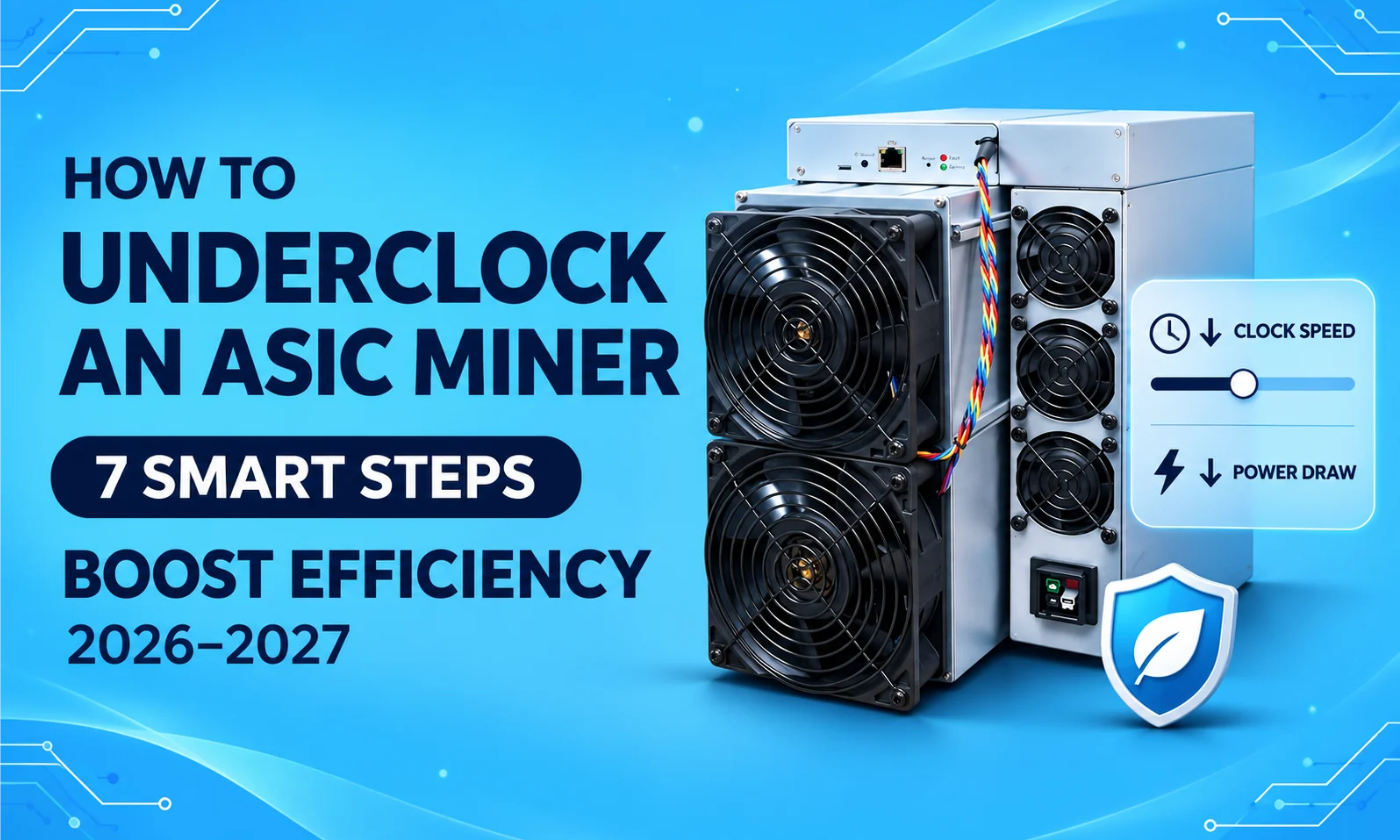
Learning how to underclock an ASIC miner is one of the smartest moves you can make in a low-hashprice market. Underclocking reduces chip frequency and voltage, which lowers hashrate slightly but cuts power use even more, improving efficiency (J/TH). It also reduces heat and noise, which is perfect for home miners. Here are seven smart steps, plus when overclocking makes more sense.
Why Underclock an ASIC Miner?
- Better efficiency: lower voltage improves J/TH, often by 10-20%
- Lower power bills: fits tighter circuits and higher electricity prices
- Less heat and noise: great for summer and home setups
- Longer hardware life: cooler chips mean less wear
- Stay profitable: after difficulty jumps or the 2028 halving
Underclocking Example
| Mode | Hashrate | Power | Efficiency |
|---|---|---|---|
| Stock S21 XP | 270 TH/s | 3,645 W | 13.5 J/TH |
| Underclocked (example) | ~225 TH/s | ~2,700 W | ~12 J/TH |
| Overclocked (example) | ~300 TH/s | ~4,500 W | ~15 J/TH |
Example values are illustrative; results vary by unit, firmware and cooling.
At $0.10/kWh and a hashprice near $37/PH/day, the stock S21 XP earns about $1.24 per day in profit, while the underclocked example earns about $1.85 per day despite lower hashrate, because power fell faster than revenue.
Step 1: Know Your Break-Even
Calculate your miner’s break-even power price with our Break-Even Electricity Calculator. If your rate is close to break-even, underclocking is usually worth it.
Step 2: Choose Firmware With Power Targets
Stock firmware often offers basic low-power modes. Aftermarket firmware like Braiins OS, VNish or LuxOS adds autotuning and precise power targets. Compare them in our ASIC miner firmware guide.
Step 3: Set a Power Target
Start by reducing power by 15-25% from stock. For an S21-class miner, try around 2,700-3,000 W.
Step 4: Let Autotuning Run
Autotuning tests each chip and finds the best voltage and frequency. Allow several hours for results to stabilize.
Step 5: Measure Real Efficiency
Use pool-reported hashrate over 24 hours and wall power from a smart PDU to calculate actual J/TH. See our ASIC efficiency guide.
Step 6: Fine-Tune by Season
Underclock more in summer to control heat; run closer to stock in winter if you reuse heat. See our ASIC miner overheating guide.
Step 7: Re-Check After Each Difficulty Adjustment
Every two weeks, compare profit at different power targets with the current hashprice from our Hashprice Tracker.
When to Overclock Instead
Overclocking increases hashrate but worsens J/TH. It only makes sense when:
- Your electricity is very cheap (under about $0.04/kWh)
- Hashprice is high
- Cooling is excellent (hydro or immersion)
Risks and Precautions
- Custom firmware may affect warranty; check warranty terms
- Download firmware only from official sources
- Never overclock air-cooled miners in hot rooms
- Monitor chip temps closely after changes
Underclock ASIC Miner: Key Takeaways
- To underclock an ASIC miner means lowering frequency and voltage to improve J/TH.
- When you underclock an ASIC miner, power falls faster than hashrate, so profit can rise at higher electricity prices.
- Firmware with power targets makes it easy to underclock an ASIC miner precisely.
- Underclock an ASIC miner more in summer to cut heat and noise.
- Re-check whether to underclock an ASIC miner after every difficulty adjustment.
- If your power is very cheap and cooling is excellent, overclocking may beat choosing to underclock an ASIC miner.
- Most miners who underclock an ASIC miner also extend its lifespan.
Underclock ASIC Miner FAQ
Does underclocking damage an ASIC?
No. Underclocking reduces stress on chips and typically extends lifespan.
How much power can I save?
Commonly 15-30%, with a smaller percentage loss in hashrate.
Can I underclock with stock firmware?
Many recent Antminers and Whatsminers offer low-power or eco modes, but options are limited compared to aftermarket firmware.
Want it done for you? Our setup and tuning service can optimize your miners. Learn more about tuning at Braiins OS.