
Bitcoin Mining in 2026: The Complete Profitability Guide – Hardware, Hosting, Pools & Power
Bitcoin mining has undergone a seismic transformation since the April 2024 halving slashed block rewards from 6.25 BTC to 3.125 BTC overnight. The question no longer is “Can I make money mining Bitcoin?” — it’s “Do I have the right hardware, the right electricity rate, and the right setup to make it work?”
This is the most comprehensive, no-fluff guide to Bitcoin mining profitability in 2026. We cover everything: what the halving really means for your margins, which hardware generation you should be running, how to choose a mining pool, whether colocation hosting makes sense, and the role of renewable energy in keeping operations lean. If you’re researching ASIC miners, browse our in-stock selection at Mine Mirth LLC — we carry the latest and older models, new and used, with expert guidance to match you with the right machine.
The Post-Halving Reality: A New Mining Landscape
The April 2024 Bitcoin halving was not a bump in the road. It was a structural reset.
Before the halving, 900 BTC were issued every single day across the entire network. Post-halving, that number dropped to 450 BTC. For miners running older hardware, the math stopped working almost immediately. Those operating at 25–30 joules per terahash (J/TH) or worse found themselves burning more electricity than they were earning in block rewards.
According to data from Hashrate Index, hashprice — the daily revenue earned per petahash of computing power — closed Q1 2026 around $23.90 per PH/s per day, a multi-year low. Meanwhile, network hashrate peaked at 1.1 ZH/s in October 2025, and mining difficulty hit an all-time high of 144.4 trillion in February 2026, a 15% single-adjustment jump — the largest since the China ban in 2021.
The two-line summary: the network is harder to mine than ever, and reward per terahash is at historic lows. But Bitcoin’s price has risen significantly, and the operators who built for efficiency are posting record revenues.
CleanSpark, for example, reported fiscal-year revenue of $766.3 million with net income of $364.5 million — a swing from a $145.8 million loss the prior year, according to CoinLaw’s mining statistics. The single biggest differentiator? Low power rates and next-generation hardware.
Who Is Actually Profitable in 2026?
Let’s be direct. Home miners paying $0.12/kWh or more on residential electricity are, in most cases, operating at a loss with any hardware rated above 15 J/TH. Industrial operators with power contracts in the $0.05–$0.08/kWh range and current-generation ASICs are running margins of 20–50% at current hashprice levels, according to Simple Mining’s profitability analysis.
The breakeven line in 2026 sits around $0.10/kWh using S21-class hardware. If your electricity rate is below that, you’re in the game. If it’s above that, the math is against you unless you’re running the most efficient machines available.
The average global cost to produce one Bitcoin among publicly listed miners reached approximately $79,995 in late 2025, according to data from CoinShares cited by CCN. That’s the institutional benchmark. Individual miners with higher power costs are staring at production costs well above the market price.
Hardware: The Efficiency Arms Race
The single most important decision you’ll make as a miner is what hardware you buy. This is not about brand loyalty — it’s about joules per terahash. Every generation of ASICs since 2018 has delivered significant efficiency improvements through semiconductor shrinks and chip architecture refinements.
Here’s what the efficiency curve looks like:
| Era | Efficiency Range |
|---|---|
| 2018 (S9-era) | ~98 J/TH |
| 2021 (S19-era) | ~30–35 J/TH |
| 2023 (S19 Pro-era) | ~23–27 J/TH |
| 2024–2026 (S21-era) | ~13–17 J/TH |
| 2026 Hydro-cooled | ~9.5 J/TH |
As Spark Money’s Bitcoin Mining Economics report explains, a modern ASIC produces the same hashrate as seven older machines while consuming the same electricity. After the halving, this efficiency gap became existential: miners running hardware above approximately 25 J/TH found themselves operating at a loss in most electricity markets.
Top Machines in 2026
Bitmain Antminer S21 Series — The S21 Pro delivers 234 TH/s at 15 J/TH with a 3,510W power draw. It generates approximately $6.55–$7.02 in daily revenue at current hashprice levels. The S21 XP (270 TH/s, 13.5 J/TH) is the most popular air-cooled machine for hosted operations.
Bitmain Antminer S23 Hydro — At 580 TH/s and 9.5 J/TH, this hydro-cooled unit is the most powerful and efficient Bitcoin miner commercially available in 2026. It requires professional hosting with three-phase power and liquid cooling infrastructure. At $0.08/kWh hosted, it earns approximately +$8.71/day net, producing BTC at an electricity cost roughly 46% below spot price.
Whatsminer M60 Series — MicroBT’s flagship line competes directly with the S21 series and is considered by Blockchain Council’s mining guide to be a “gold standard” option alongside the Antminer S21.
Ready to find the right ASIC for your setup? Mine Mirth LLC stocks new and used models, from entry-level to enterprise-grade. Our team provides expert guidance to match you with the best machine for your budget and power situation. Shop ASIC miners at Mine Mirth →
You can also run your numbers before buying using our free Bitcoin Mining Calculator and our ASIC Market Scope tool for long-term ROI projections.
The Bitcoin Halving: What It Means Long-Term
The April 2024 halving was the fourth in Bitcoin’s history. Every ~four years, the block subsidy cuts in half — a deflationary mechanism written into Bitcoin’s code to enforce its 21-million-coin supply cap.
Here’s what the halving has done to the industry:
It accelerated consolidation. Miners with thin margins and older hardware shut down. Network hashrate dipped briefly after the halving, then resumed its long-term upward trend as new, more efficient hardware came online and Bitcoin’s price appreciated.
It restructured revenue. As Spark Money explains, the industry is now mid-transition from a block-subsidy-funded model to one increasingly dependent on transaction fees. This will intensify with each subsequent halving.
It made efficiency non-negotiable. The AMINA Bank post-halving landscape report found that the network’s weighted average efficiency could reach as low as 10 W/T by mid-2026 as chip design continues to advance. Operators still running legacy hardware are not just slightly disadvantaged — they’re economically insolvent.
It pushed miners toward renewables. With profitability margins squeezed, miners have increasingly moved toward cheaper, cleaner energy sources. According to the Cambridge Centre for Alternative Finance, sustainable energy now powers 52.4% of Bitcoin mining — including 9.8% nuclear and 42.6% renewables. The United States accounts for 75.4% of reported mining activity in the CCAF’s 2025 sample.
Mining Pools: Where to Point Your Hashrate
Solo mining is essentially dead for any individual or small operation. With a network hashrate above 826 EH/s even at its lowest recent point, the probability of finding a block as a solo miner is so statistically remote it borders on lottery odds.
Mining pools combine hashrate from many participants to find blocks more consistently and share rewards proportionally to each miner’s contribution. Here are the major pools in 2026, according to Koinly’s pool comparison and Hashrate Index’s pool rankings:
Foundry USA
The largest Bitcoin mining pool in 2026, commanding roughly 30% of network hashrate as of May 2026. US-based, backed by Digital Currency Group, SOC 2 Type 2 certified, and the standard for institutional compliance. Uses the FPPS payout method. Best for North American professional and industrial miners.
AntPool
Owned by Bitmain, AntPool is the default pool for many Bitmain hardware users and maintains a strong global presence, particularly across Asia. FPPS payouts, large hashrate share, and long operational history.
ViaBTC
Founded in 2016, ViaBTC is one of the most globally entrenched pools with particular strength in Russia and surrounding regions. One of the first pools to adopt PPS, offering a stable base reward plus transaction fee sharing. Consistently top-three by hashrate.
F2Pool
Established in 2013, F2Pool is one of the oldest operating pools with a strong global server footprint across Asia, Europe, and North America. It supports multiple cryptocurrencies, making it flexible for miners running varied hardware.
Luxor
A US-based pool that has evolved into a full mining stack. Luxor pioneered fixed and upfront pool payouts — letting miners lock in revenue before the hashrate is delivered. Integrates custom firmware (LuxOS) and hashrate derivatives. SOC 2 certified. Best for operations that want institutional-grade reporting and financial products alongside their pool.
Braiins Pool
Formerly Slushpool, the oldest Bitcoin mining pool still running (active since 2010). Known for pioneering stratum V2, a more efficient and decentralized mining protocol. Solid choice for miners who prioritize network decentralization.
Choosing a pool: Match your scale to the pool’s strengths. Home and small miners benefit from low payout thresholds and FPPS to smooth variance. Mid-size operations need reliable tooling. Large fleets should consider spreading hashrate across two or three pools to reduce single-operator risk. As Simple Mining notes, a 4% uptime gap costs roughly four times more than a 1% fee gap — reliability matters more than chasing the lowest fee.
Hosting and Colocation: The Smart Move for Most Miners
One of the most powerful shifts in the industry since the halving is the rapid growth of hosted mining — where you own the ASIC miner, but a professional facility handles power, cooling, installation, monitoring, and maintenance. You receive the Bitcoin directly into your wallet.
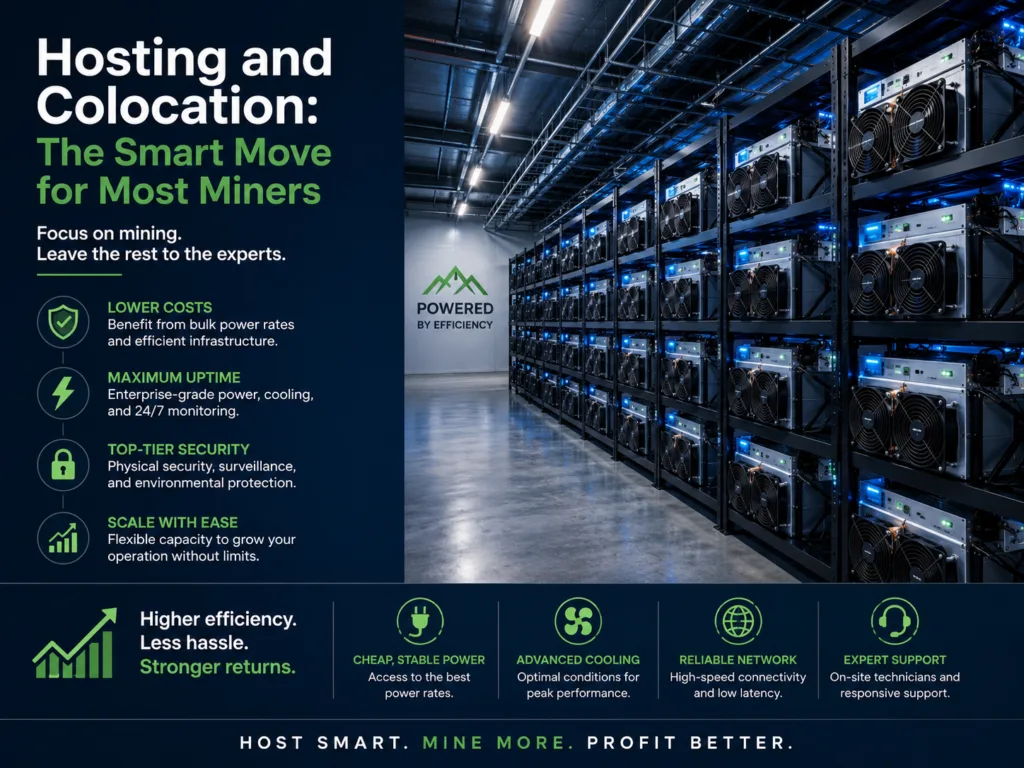
This model solves the single biggest problem most individual miners face: electricity cost. Hosting facilities have industrial power contracts in the $0.05–$0.08/kWh range that residential miners simply cannot match.
How Colocation Works
You purchase your miner (from a trusted seller like Mine Mirth LLC), ship it to the facility, and pay a monthly all-in hosting fee that covers rack space, power, cooling, and maintenance. You keep 100% of what you mine, minus the hosting cost.
What to Look For in a Host
Based on the landscape in 2026, here are the key criteria:
- All-in electricity rate: Target $0.07–$0.08/kWh or below
- Uptime guarantee: 95% is the industry minimum; top facilities deliver 98–99%
- Ownership structure: Hosts that own their facilities are more accountable than brokers
- Repair coverage: On-site repair turnaround is a major profitability lever most investors overlook
- Transparency: Avoid hosts that skim mining revenue through hidden “maintenance fees.”
- Contract flexibility: Pause-friendly contracts protect you during market downturns
Notable hosting providers in 2026 include Simple Mining (Iowa-based, $0.07–$0.08/kWh, free 12-month repairs), EZ Blockchain (60 MW of US capacity, $0.055/kWh starting, both air-cooled and immersion options), and Hut 8 (1,020 MW under management, institutional-grade colocation).
For miners who prefer to track all their operational metrics, WhatToMine and MinerStat are widely used tools for monitoring real-time profitability across coins and hardware configurations.
Renewable Energy: The Competitive Advantage You Can’t Ignore
If there’s one macro trend reshaping Bitcoin mining in 2026, it’s the aggressive shift toward renewable and low-cost energy sources.
Miners using solar, hydroelectricity, natural gas flaring, or excess wind power have a structural advantage that compounds over time. Their production cost per Bitcoin is dramatically lower, which means they remain profitable at lower BTC prices and earn more margin when prices are high.
According to the Bitcoin Foundation’s 2026 mining overview, energy used for Bitcoin mining is disproportionately sourced from renewable and stranded sources — hydropower, natural gas flaring, and excess solar and wind. The United States leads with 75.4% of reported mining activity, with Russia at 17% and China at 12%.
The Cambridge Centre for Alternative Finance now reports that 52.4% of Bitcoin mining is powered by sustainable energy — a figure that has steadily climbed as the post-halving economics made low-cost power not just attractive but necessary.
From an ESG standpoint, miners disclosing higher renewable percentages are also attracting more institutional capital — a secondary benefit that goes beyond the immediate bottom line.
Profitability Calculators: Do the Math Before You Commit
Before buying any hardware, run the numbers. Here’s the daily profitability formula every miner should know:
Daily electricity cost = (Miner wattage ÷ 1,000) × 24 hours × your $/kWh rate
Subtract that from your daily mining revenue (calculated using your hashrate, current hashprice, and pool fee), and you have your net daily profit or loss.
Key real-world benchmarks in 2026:
- S21 XP (270 TH/s, 13.5 J/TH) at $0.08/kWh hosted: approximately +$1.98/day
- S23 Hydro (580 TH/s, 9.5 J/TH) at $0.08/kWh hosted: approximately +$8.71/day
- Any air-cooled machine at $0.12+/kWh residential: operating at a loss
Use our free Bitcoin Mining Calculator to plug in your specific hardware, electricity rate, and pool fee for a personalized projection. Our Mining Rig Optimizer uses AI-driven analysis to help you find the optimal configuration.
For live hash price data, Hashrate Index is the industry’s most-cited source. For real-time network stats and pool distribution, mempool.space provides transparent, raw blockchain data.
Mining Tax Basics: What You Owe the IRS
Mining income is taxable. In the United States, the IRS treats mined Bitcoin as ordinary income at the fair market value on the day it is received. When you later sell, exchange, or spend that Bitcoin, any gain or loss from the acquisition price is subject to capital gains tax.
Key considerations:
- Keep detailed records of every mining payout: date, amount in BTC, USD value at receipt
- Hardware purchases are depreciable business assets
- Electricity costs and hosting fees are deductible business expenses
- Mining as a business vs. a hobby is determined by the IRS based on profit motive, regularity, and other factors
For detailed tax treatment of mining income, Koinly’s crypto tax guides are a widely-used resource among miners, and CoinLaw’s mining statistics page contains a solid overview of IRS treatment in the context of mining economics.
This is not tax advice. Consult a qualified CPA familiar with cryptocurrency before filing.
Is Bitcoin Mining Worth It in 2026? The Bottom Line
Bitcoin mining is profitable in 2026 — but only for operators who treat it like a business.
The window for casual, residential mining has largely closed. The era of plugging in an S9 and printing money is long gone. What has replaced it is a more sophisticated, capital-intensive, efficiency-driven industry where margins are won or lost on the electricity rate, hardware generation, and operational uptime.
You can still mine profitably if:
- Your electricity rate is at or below $0.10/kWh
- You’re running current-generation hardware (S21-class or better)
- You join a reputable mining pool
- You track your metrics and treat them as a business
The smartest moves in this environment:
- Buy efficient, current-generation hardware — don’t chase discounted older models
- Use colocation hosting if you can’t access industrial power rates on your own
- Join an established pool (Foundry USA, AntPool, Luxor, ViaBTC)
- Run the profitability calculator before committing capital
- Hold your mined BTC rather than selling at every dip
At Mine Mirth LLC, we supply ASIC miners — latest and older models, new and used, in-stock and available for pre-order — along with genuine miner parts and expert guidance to maximize your mining profitability. Whether you’re just getting started or scaling an existing operation, our team is available 24/7 via WhatsApp at +1 (249) 202-4891 or email at support@minemirth.com.
Further Reading
- Why a Bitcoin ASIC Miner Beats Buying Crypto Directly — Mine Mirth LLC
- Antminer Z15 Pro Profitability Review 2026 — Mine Mirth LLC
- What is Bitmain? The Crypto Mining Giant Explained — Mine Mirth LLC
- Bitcoin Mining in 2025: Is It Still a Gold Rush? — Mine Mirth LLC
- Bitcoin Mining Economics 2026: Post-Halving Reality — Spark Money
- Crypto Mining Profitability Statistics 2026 — CoinLaw
- Top 10 Bitcoin Mining Pools 2026 — Hashrate Index
- Best Bitcoin Mining Hosting Providers 2026 — MEXC News
- Best Cryptocurrencies to Mine 2026 — DEXTools