
Hydro-cooled miners have water cold plates bolted to their hashboards instead of fans. A coolant loop carries the heat away. They are quiet, dense and among the most efficient miners available, but they are a system, not a plug-and-play box.
The parts of a hydro system
- Supply and return manifolds that connect each miner to the loop.
- Pump sized for the total flow rate and pressure drop.
- Filter to keep particles out of the cold plates.
- Heat rejection: a dry cooler, cooling tower or heat exchanger to a heat-reuse loop.
- Coolant: treated water or a glycol mix, with corrosion inhibitors.
- Sensors for flow, temperature, pressure and leaks.
Follow the spec sheet
Each hydro model specifies a coolant flow rate per unit (often in the range of several litres per minute), an inlet temperature range, a maximum pressure and coolant quality requirements. Running outside those values risks overheating, condensation or corrosion. Design the loop around the exact model you buy.
Power
Hydro miners often draw more power per unit than air-cooled ones and commonly use high-voltage single-phase or three-phase supplies. Plan the electrical side with the same care as the loop. See the power & electrical guide.
Heat reuse
Return coolant leaves hydro miners warm, which is ideal for heating buildings, greenhouses, pools or drying processes through a heat exchanger. Heat sold or reused can materially improve the economics. See mining for businesses.
Keep coolant inlet temperature above the room’s dew point. Cold coolant in a humid room causes condensation on the miner, a short-circuit risk.
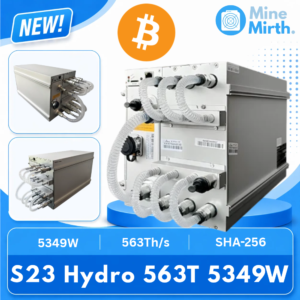
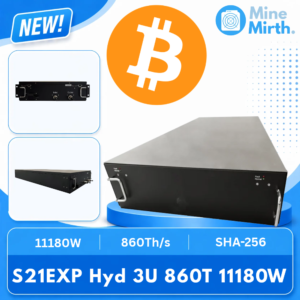
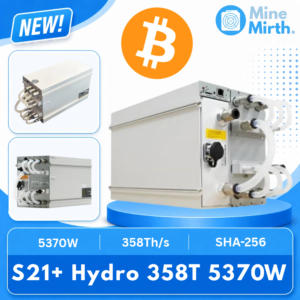
Hydro miners

Running hydro-cooled miners day to day
Water quality
Follow the manufacturer’s coolant specification. Most hydro-cooled miners expect clean, treated water or a specified coolant mix, filtered to remove particles. Poor water quality causes scaling and corrosion inside the cold plates, which slowly reduces cooling.
Flow and temperature
Monitor flow rate and inlet and outlet temperatures for every rack. A drop in flow is often the first sign of a blocked filter or a failing pump. Keep inlet temperature inside the specified window: too warm reduces performance, too cold risks condensation.
Leaks and maintenance
Use quality hoses and quick connectors, check them during routine maintenance and keep leak detection under the racks. With good water and steady flow, hydro-cooled miners are among the most reliable machines in a site.
Using the heat
The warm outlet water is a real asset. It can heat buildings, greenhouses or process water through a heat exchanger. If you can sell or use the heat, hydro-cooled miners become even more attractive. See our hydro miners for models.
Planning the loop
Size pumps and heat rejection for the full load at your hottest expected weather. Include valves to isolate each rack, filters that are easy to reach and enough spare capacity to add miners later. A well-designed loop is quiet, simple to service and lets hydro-cooled miners run at their rated efficiency all year.
Costs
Hydro sites cost more to build than air-cooled ones, mainly for the loop and heat rejection equipment. In return, they fit more hashrate into less space, cut noise and can earn money from heat, which can make the total cost per terahash lower over the life of the site.
Getting started
If you are new to liquid cooling, start with a small loop and a few units before scaling. You will learn the routines for filling, bleeding air, checking flow and servicing filters, and those habits make a larger hydro site run smoothly. Ask us which hydro models we have in stock and what each needs.
Choosing a coolant
Use the coolant the manufacturer specifies, or treated water within its stated limits, and check it on a schedule. Mixing coolants or topping up with untreated tap water can shorten the life of cold plates and pumps.
Questions, answered
Can I use tap water?
Use the coolant the manufacturer specifies. Untreated tap water causes scaling and corrosion.
What happens if the pump fails?
Miners overheat and shut down within minutes. Use flow alarms, and consider a redundant pump for larger loops.