


Looking for the best home Bitcoin miner in 2026? You are not alone. With network hashrate now sitting around 1 ZH/s and hashprice hovering near $37 per PH/s per day, picking the wrong machine for your garage, basement or spare room can turn a fun side project into a loud, money-losing space heater. This guide ranks the most practical home Bitcoin miner options by noise, power draw, efficiency and real-world profitability, so you can buy once and buy right.
We work with home miners every week at Mine Mirth LLC, and the same questions keep coming up: Will it trip my breaker? Will my family hear it? Will it actually pay for itself? Let’s answer all three.
Quick Answer: The Best Home Bitcoin Miner by Use Case
- Best overall for a garage or basement: Antminer S21 XP (270 TH/s, 13.5 J/TH)
- Best quiet home Bitcoin miner for living spaces: Fluminer T3 (105 TH/s, ~1,650 W)
- Best mid-power home miner: Canaan Avalon Q (90 TH/s, ~1,674 W)
- Best value air-cooled workhorse: Antminer S21 Pro (234 TH/s, 15 J/TH)
- Best for learning and solo “lottery” mining: Bitaxe Gamma (~1.2 TH/s)
- Best desk-friendly heater-miner: Avalon Nano 3S (~6 TH/s, ~140 W)
- Best for heat reuse: Antminer S21 XP Hydro paired with a water loop (473 TH/s)
What Makes a Good Home Bitcoin Miner in 2026?
A machine that dominates in an industrial farm is not automatically the right home Bitcoin miner. Data centers care only about joules per terahash. At home, you have to balance five things:
- Noise (dB): Standard air-cooled ASICs run at 75 dB or more, about as loud as a vacuum cleaner. Anything under 50 dB is tolerable inside a home.
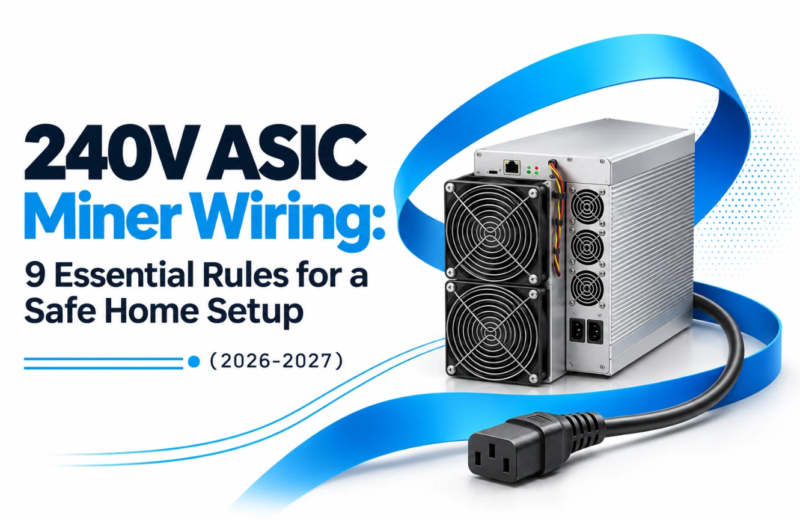
- Power and circuit: Most homes in the US run 120V/15A circuits that safely deliver about 1,440 W continuous. Full-size ASICs need a dedicated 240V circuit.
- Efficiency (J/TH): Lower is better. Under 17 J/TH is the 2026 sweet spot for staying profitable after difficulty increases.
- Heat output: Every watt becomes heat. In winter that is a bonus; in summer you need ventilation.
- Your electricity rate: The single biggest factor in whether any miner is profitable.
Not sure how much your circuit can handle? Run your numbers through our free Mining Power Calculator & Circuit Planner before you buy.
Home Bitcoin Miner Comparison Table (2026)
| Miner | Hashrate | Power | Efficiency | Noise | Circuit |
|---|---|---|---|---|---|
| Antminer S21 XP | 270 TH/s | 3,645 W | 13.5 J/TH | ~76 dB | 240V |
| Antminer S21 Pro | 234 TH/s | 3,510 W | 15 J/TH | ~76 dB | 240V |
| Antminer S21 XP Hydro | 473 TH/s | 5,676 W | 12 J/TH | Low (water-cooled) | 240V |
| Fluminer T3 | 105 TH/s | ~1,650 W | ~15.7 J/TH | ~55 dB (claimed) | 240V recommended |
| Canaan Avalon Q | 90 TH/s | ~1,674 W | ~18.6 J/TH | Home-tuned, low | 240V / eco mode |
| Avalon Nano 3S | ~6 TH/s | ~140 W | ~23 J/TH | Near silent | Standard outlet |
| Bitaxe Gamma | ~1.2 TH/s | ~18 W | ~15 J/TH | Near silent | DC power supply |
Specs are manufacturer ratings and vary by firmware and hashboard revision. Compare models side by side with our ASIC Miner Comparison tool.
1. Antminer S21 XP: Best Overall Home Bitcoin Miner for Garages
If you have a garage, shed or ventilated basement and a 240V outlet, the S21 XP is the most efficient air-cooled machine most home miners can realistically buy. At 13.5 J/TH it keeps earning long after older machines go underwater.
Real-world math: At a hashprice of roughly $36.75/PH/day, 270 TH/s earns about $9.90 per day in revenue. It uses about 87.5 kWh per day. At $0.06/kWh your power cost is ~$5.25, leaving roughly $4.65/day. At $0.12/kWh, it slips into a loss. That is why your rate matters more than anything else.
Downside: 76 dB. Do not put it in a bedroom. See our guide on reducing ASIC noise for sound-box and shroud ideas.
2. Fluminer T3: The Quiet Home Bitcoin Miner
The Fluminer T3 is built specifically for homes. With roughly 105 TH/s at about 1,650 W and a claimed noise level near 55 dB, it can sit in a utility room or office without driving everyone crazy. Efficiency is competitive at around 15–16 J/TH.
Daily revenue: about $3.85. Power use is ~39.6 kWh/day, so at $0.06/kWh you net roughly $1.45/day. Its real advantage is that it doubles as a quiet space heater during cold months, effectively turning your heating bill into mining.
3. Canaan Avalon Q: Best Mid-Power Home Miner
Canaan designed the Avalon Q for residential users who want serious hashrate without industrial noise. It offers multiple power modes, so you can run a lower eco mode or push it harder on 240V. Efficiency (around 18.6 J/TH) is behind the S21 series, but the home-friendly design and app control make it a favorite among first-time miners.
4. Antminer S21 Pro: Best Value Workhorse
The S21 Pro delivers 234 TH/s at 15 J/TH and is widely available, which keeps prices reasonable. For home miners who already have a dedicated 240V circuit and a space where noise does not matter, it is one of the best dollars-per-terahash buys of 2026. Browse current stock in our Bitcoin miners collection.
5. Bitaxe Gamma: Best Home Bitcoin Miner for Learning
The open-source Bitaxe Gamma will not pay your electricity bill, and that is not its goal. At ~1.2 TH/s and under 20 W, it is a silent, tiny device that lets you solo mine and take a lottery ticket at a full block reward of 3.125 BTC plus fees. It is also the cheapest way to learn pools, firmware and hashrate tuning. Check your real odds with our Solo Mining Odds Calculator.
6. Avalon Nano 3S: Desk-Friendly Heater-Miner
The Nano 3S packs about 6 TH/s into a compact unit that plugs into a regular wall outlet and doubles as a small heater. Like the Bitaxe, think of it as a learning tool and a lottery ticket, not an income machine.
7. Antminer S21 XP Hydro: Best for Heat Reuse
Hydro miners are quiet because the fans move outside to a radiator or dry cooler. With 473 TH/s at 12 J/TH, an S21 XP Hydro paired with a hot-water tank, pool heater or radiant floor loop can offset real heating costs. It is an advanced project that requires plumbing and heavy-duty 240V wiring. Learn more in our hydro-cooled miners guide.
Is a Home Bitcoin Miner Still Profitable in 2026?
Network difficulty climbed to about 140.58 trillion in mid-October 2026 after a 5.92% jump, according to Bitcoin.com News. That means revenue per terahash keeps shrinking unless BTC price rises. Here is a simple rule of thumb for home mining:
- Under $0.07/kWh: Modern efficient miners (S21 XP, S21 Pro, T3) are profitable.
- $0.07–$0.10/kWh: Only the most efficient machines make money; heat reuse helps.
- Above $0.10/kWh: Home mining is mostly a heating or hobby play. Hosting is usually better.
Track daily revenue trends on our Hashprice Tracker, and model your payback period with the Mining ROI & Payback Planner. For broader market data, Hashrate Index publishes a useful machine ranking too.
Home Bitcoin Miner Setup Checklist
- Confirm your electrical capacity. Never run a full-size ASIC on a shared 120V household circuit. Hire a licensed electrician for a dedicated 240V line. Our ASIC power and electrical guide explains PDUs, breakers and cables.
- Plan airflow. Pull cool air in and push hot air outdoors or into a room you want heated. See cooling and ventilation tips.
- Use wired Ethernet. Most ASICs do not support Wi-Fi, and a stable connection reduces stale shares.
- Join a reputable pool. Compare payout methods in our PPS vs FPPS vs PPLNS guide.
- Tune firmware. Underclocking can cut noise and power while improving J/TH. Learn how in ASIC firmware and tuning.
- Secure your payouts. Send rewards to a wallet you control.
Home Mining vs. Hosting: Which Should You Choose?
If your power costs more than about $0.10/kWh, or you simply do not want 76 dB of fan noise at home, hosting your miner in a professional facility is often the smarter move. You keep ownership of the machine while it runs on industrial electricity rates with proper cooling and uptime monitoring. Compare both scenarios in the Hosting vs Home Mining Calculator, or explore Mine Mirth miner hosting.
Frequently Asked Questions
What is the quietest home Bitcoin miner?
Small devices like the Bitaxe Gamma and Avalon Nano 3S are near silent. For serious hashrate, the Fluminer T3 and Canaan Avalon Q are designed for low-noise residential use, while hydro-cooled units are quiet at the miner itself.
Can I run a home Bitcoin miner on a normal outlet?
Only small units such as the Bitaxe, Nano 3S and some home miners in eco mode. Full-size ASICs drawing 3,000 W or more require a dedicated 240V circuit.
How much does a home Bitcoin miner cost to run?
Multiply the miner’s kW rating by 24 hours and your rate. A 3.5 kW machine at $0.10/kWh costs about $8.40 per day to run.
Should I buy a used ASIC for home mining?
Used machines can be a bargain but carry risk. Read our checklist on buying used ASIC miners before you commit.
Final Verdict
The best home Bitcoin miner is the one that fits your power rate, your space and your noise tolerance. For most garages with cheap power, the Antminer S21 XP is the strongest pick. For living spaces, choose the Fluminer T3 or Avalon Q. And if you just want to learn and chase a block, a Bitaxe is a fun, low-risk start.
Ready to buy? Shop our curated home miners or contact the Mine Mirth team for a free setup recommendation based on your electricity rate.

[…] Home mining: full control; needs space, power and noise tolerance (best home bitcoin miner) […]