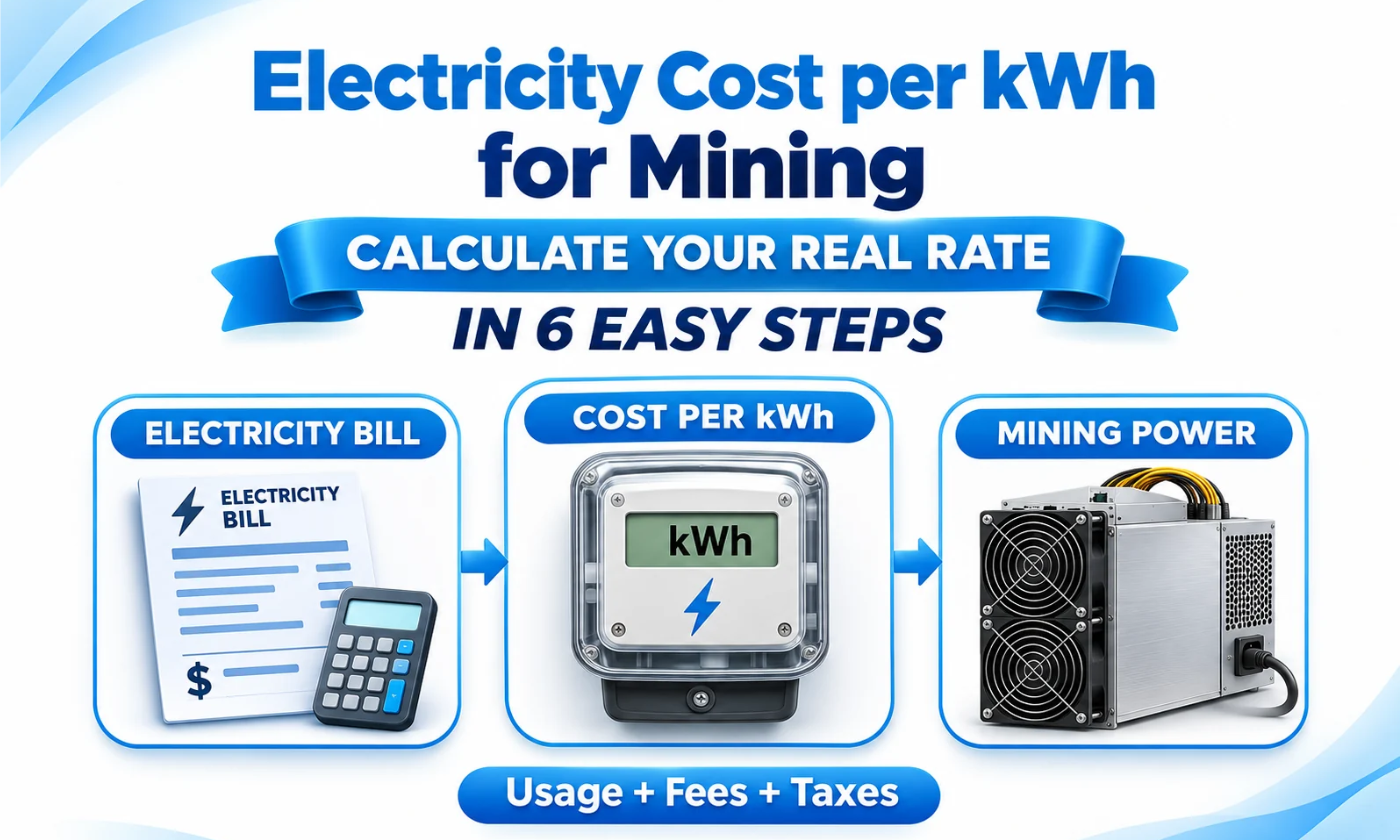
Your electricity cost per kWh for mining is the most important number in your whole operation, and most new miners get it wrong. The Bitcointalk guide “How to calculate your cost per kWh” has more than 28,000 views because people keep discovering that their “10-cent power” is really 15 or 16 cents once fees are added. This guide shows how to find your true rate in six steps and what every cent means for a real miner’s profit.
Why Electricity Cost per kWh for Mining Matters So Much
An ASIC runs 24 hours a day, 365 days a year. An Antminer S21 XP uses about 87.5 kWh per day, or about 31,900 kWh per year. A difference of just one cent per kWh is about $319 per year, per machine. Across 10 machines, that one cent is $3,190. Power is typically 80-90% of a miner’s running cost.
Step 1: Get Your Last 12 Electric Bills
One bill can mislead you because of seasonal rates. Download a full year from your utility’s website if possible. You need two numbers from each bill: the total amount paid and the total kWh used.
Step 2: Divide Total Dollars by Total kWh
This is your all-in electricity cost per kWh for mining. Example: a bill of $186.40 for 1,150 kWh equals $0.162/kWh. Do not use the “energy charge” line alone. That line might say $0.10/kWh while the real all-in rate is 60% higher.
Step 3: Find the Hidden Charges
Utility bills usually include several pieces. Only some of them scale with kWh:
| Bill item | Scales with kWh? | What to do |
|---|---|---|
| Energy or generation charge | Yes | Include |
| Delivery, transmission or distribution | Yes (usually) | Include |
| Fuel or power cost adjustment | Yes | Include |
| Taxes and regulatory riders | Yes (usually %) | Include |
| Fixed customer or meter charge | No | Exclude when estimating added mining cost |
| Demand charge (commercial) | Based on peak kW | Calculate separately |
For the most accurate marginal electricity cost per kWh for mining, add up only the per-kWh items and divide by kWh.
Step 4: Check for Tiered and Time-of-Use Rates
Tiered rates charge more once you pass a monthly threshold. A miner pushes you into the highest tier, so use the top tier price. Time-of-use (TOU) rates charge more during peak hours, often 4-9 pm. A miner running 24/7 pays a blend. Weighted example: 5 peak hours at $0.30 and 19 off-peak hours at $0.11 gives about $0.15/kWh. Some miners schedule their machine to sleep during peak hours to cut this cost.
Step 5: Add Cooling Overhead
If you need fans, an exhaust system or air conditioning to keep the miner cool, that power counts too. A simple exhaust fan adds 1-3%. Air conditioning can add 30-50%, which is why miners vent heat outside instead of cooling a room. Hydro miners with a 12KW radiator use far less cooling power than AC.
Step 6: Turn Your Rate Into Profit
With your true electricity cost per kWh for mining in hand, see what an Antminer S21 XP earns per day at today’s hashprice of about $33 per PH/s per day ($8.91 revenue per day):
| Electricity cost per kWh | Power cost/day | Profit/day | Profit/year |
|---|---|---|---|
| $0.04 | $3.50 | $5.41 | $1,975 |
| $0.06 | $5.25 | $3.66 | $1,336 |
| $0.08 | $7.00 | $1.91 | $697 |
| $0.10 | $8.75 | $0.16 | $58 |
| $0.12 | $10.50 | -$1.59 | -$580 |
| $0.16 | $14.00 | -$5.09 | -$1,858 |
The same machine goes from almost $2,000 profit to almost $1,900 loss per year, purely because of electricity cost per kWh. Use the ROI and Payback Planner to run your own rate, and compare more machines in our break-even electricity cost table.
Residential vs Commercial vs Hosting Rates
- Residential: the US average is roughly $0.16-$0.18/kWh all-in, with big state differences. Check the latest figures from the US Energy Information Administration.
- Commercial and industrial: lower energy rates, but demand charges based on your peak kW. Mining’s flat load can work well here.
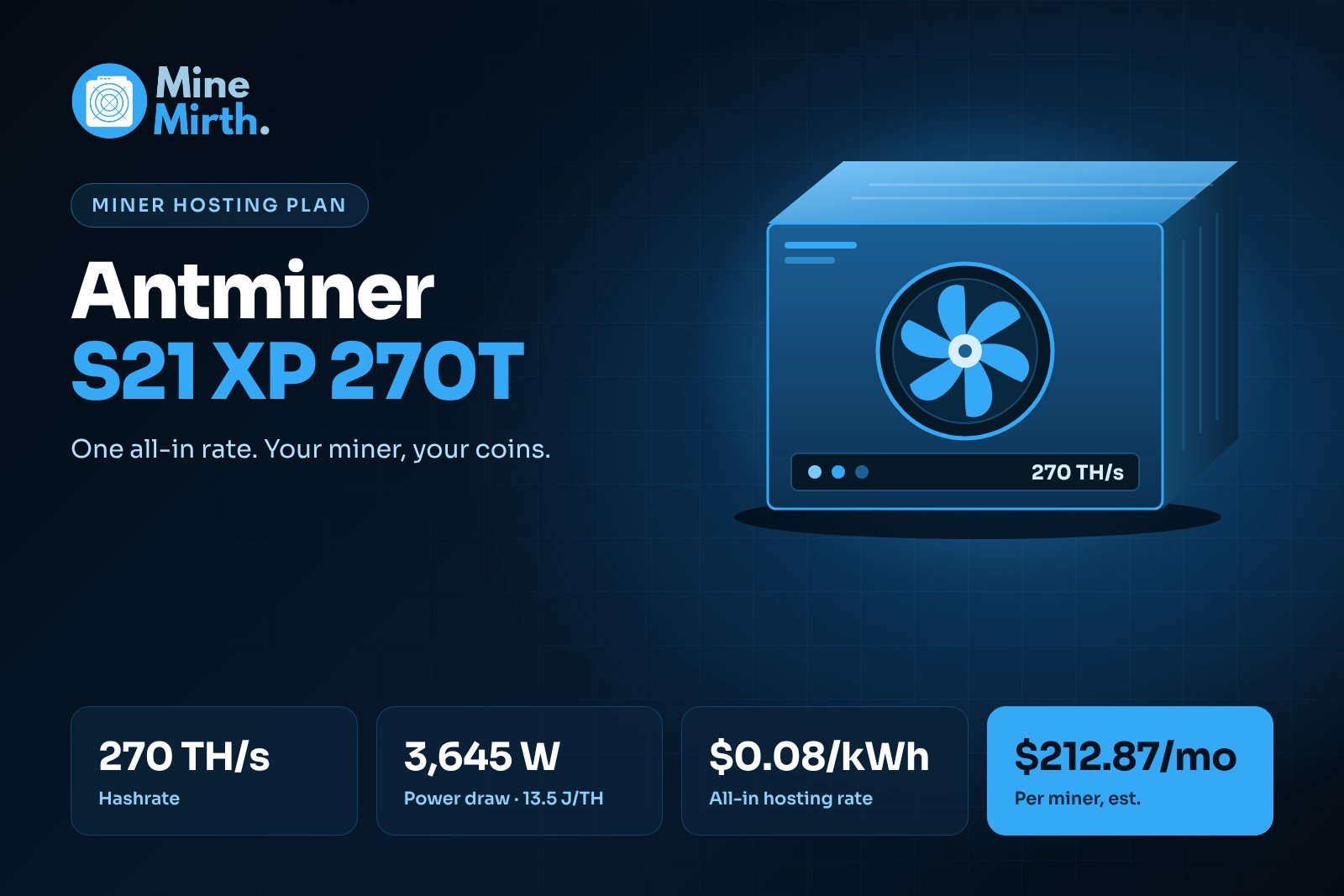
- Hosting: professional facilities usually quote one all-in rate covering power, cooling, security and monitoring. Compare it directly with your home number. See Mine Mirth miner hosting and the ASIC miner hosting guide.
5 Ways to Lower Your Electricity Cost per kWh for Mining
- Ask your utility about TOU, EV or off-peak plans and run miners off-peak.
- Add solar, which lowers your daytime cost. See our solar Bitcoin mining guide.
- Use the heat in winter to replace other heating, which reduces your net cost.
- Underclock miners during high-price hours with tuned firmware.
- Move machines to a host when your home rate is above about $0.08/kWh.
FAQ: Electricity Cost per kWh for Mining
What is a good electricity cost per kWh for mining?
Under $0.06/kWh is excellent, $0.06-$0.08 is good, and above $0.10 makes most full-size miners unprofitable at today’s hashprice.
How much power does a miner use per month?
Multiply watts by 24 hours by 30 days and divide by 1,000. A 3,645 W S21 XP uses about 2,624 kWh per month. Our power consumption guide shows more examples.
Does my mining circuit need a separate meter?
Not usually, but a smart plug or sub-meter helps you track exact use. Plan circuits with the Mining Power Circuit Planner.
The Bottom Line
Find your real electricity cost per kWh for mining before you buy anything. It decides which miner makes sense and whether you should mine at home or host. Not sure about your number? Send Mine Mirth your bill details and we will help you calculate it, or explore the most efficient miners to stretch every kWh further.