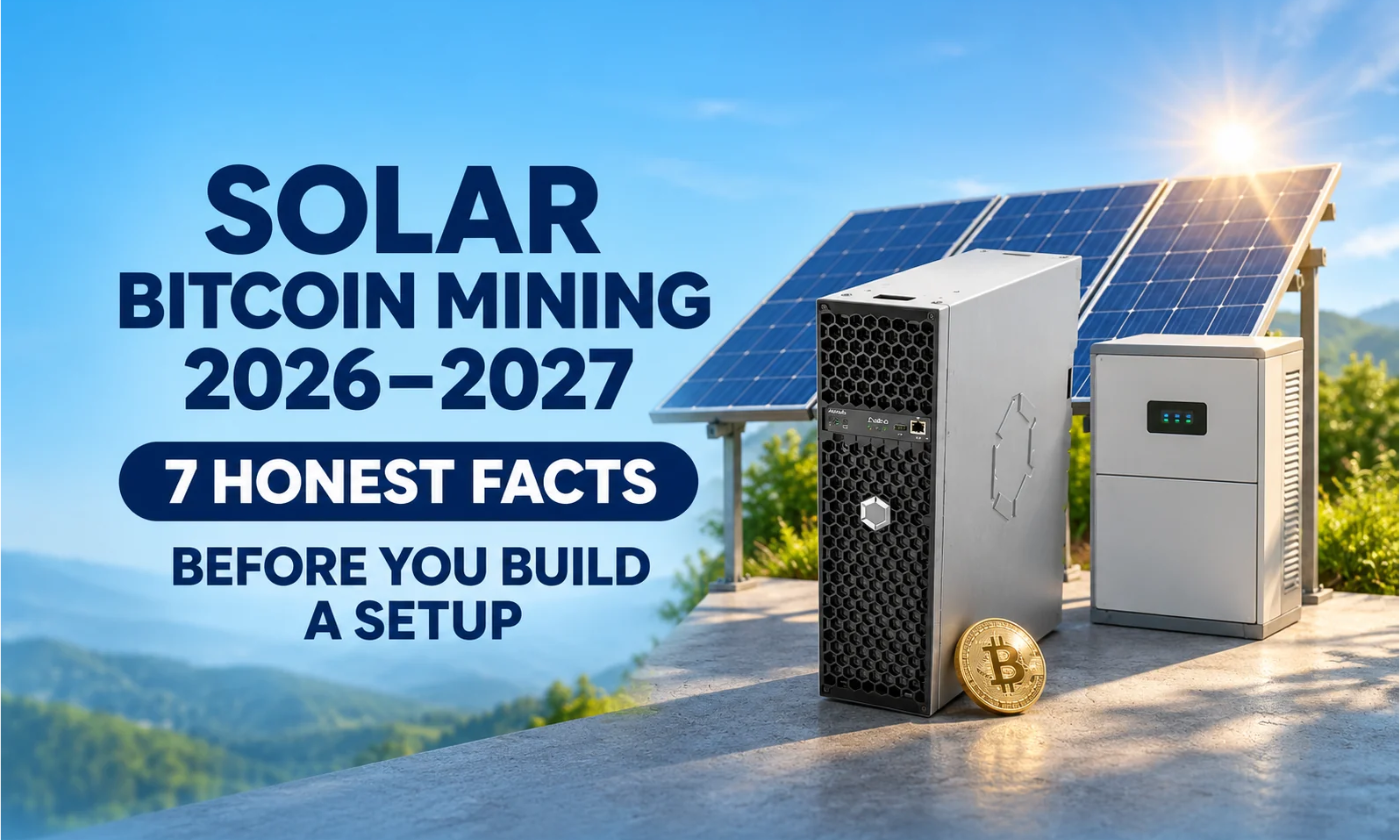
Solar bitcoin mining sounds like the perfect combination: free sunshine turned into Bitcoin. In reality, it can work very well, but only if you size the system correctly and understand that most solar setups only mine during daylight. Here are seven honest facts to help you decide if solar powered Bitcoin mining makes sense in 2026-2027.
Fact 1: Solar Power Is Not Free, It Is Prepaid
Solar panels cost money upfront. Your effective electricity cost equals the system cost divided by the energy it produces over its life. A well-priced residential system often delivers energy at roughly $0.04-$0.08/kWh over 20-25 years, which can be very competitive with grid power for mining.
Fact 2: You Need More Panels Than You Think
A 3.5 kW ASIC running 24 hours needs about 84 kWh per day. A typical solar panel (around 400-450 W) produces roughly 1.6-2.2 kWh per day depending on location and season.
| Miner | Daily Energy | Panels for 24/7 (approx.) | Panels for Daytime Only |
|---|---|---|---|
| Avalon Nano 3S (140 W) | 3.4 kWh | 2-3 + battery | 1 |
| Avalon Mini 3 (800 W) | 19 kWh | 10-12 + battery | 3-4 |
| Avalon Q (1,674 W) | 40 kWh | 20-25 + battery | 6-8 |
| Antminer S21 XP (3,645 W) | 87 kWh | 45-55 + battery | 12-15 |
Real numbers depend on your sun hours, panel angle and losses. Use a tool like NREL PVWatts to estimate your site’s production.
Fact 3: Batteries Usually Don’t Pay for Mining
Storing solar energy in batteries to mine overnight is expensive. Most profitable solar mining setups run daytime-only, using excess production that would otherwise be exported cheaply to the grid.
Fact 4: Mining Excess Solar Can Beat Net Metering
If your utility pays only a few cents per kWh for exported solar, using that excess to mine can earn more. At a hashprice of about $37/PH/day, an S21 XP earns roughly $0.114 per kWh it consumes, often more than export credits.
Fact 5: Choose Miners That Can Throttle
Solar output changes through the day. Miners with adjustable power modes or firmware power targets can follow production. Look for models supported by firmware with power scaling (firmware guide) or home miners with app-controlled modes like the Avalon Q.
Fact 6: Heat and Noise Still Matter
Solar mining usually happens in summer daytime, the hottest hours. Plan ventilation carefully (overheating guide).
Fact 7: Payback Depends on Your Alternatives
Compare three options for your solar energy: using it in your home, exporting it, or mining with it. Mining wins when export rates are low and hashprice is healthy.
Example: Daytime Solar Mining With an Avalon Q
- Runs about 6 hours/day at full power on solar = ~10 kWh
- Hashprice $37/PH/day = about $0.83 of revenue for those 6 hours
- Monthly: ~$25 in BTC from solar that might otherwise earn a few dollars in export credits
Not life-changing, but it adds up, and it scales with more panels and miners.
Best Miners for Solar Bitcoin Mining
| Use Case | Good Choice |
|---|---|
| Small system (under 2 kW excess) | Avalon Mini 3, Avalon Nano 3S |
| Medium system (2-5 kW excess) | Avalon Q, Fluminer T3 |
| Large system or farm | Antminer S21/S23 series with power-scaling firmware |
Browse home miners at Mine Mirth.
Solar Bitcoin Mining: Key Takeaways
- Solar bitcoin mining works best with excess daytime production.
- Batteries rarely pay off for solar bitcoin mining around the clock.
- Choose miners with adjustable power for solar bitcoin mining.
- Solar bitcoin mining can beat low net-metering export rates.
- Size your array carefully; solar bitcoin mining needs more panels than most people expect.
Solar Bitcoin Mining FAQ
Can I run a Bitcoin miner directly from solar panels?
You need an inverter (or a DC-compatible setup) to supply stable AC power. Most setups use a hybrid inverter with grid backup.
Is off-grid solar mining profitable?
It can be with very cheap panels and good sun, but battery costs usually make 24/7 off-grid mining hard to justify.
Does solar mining help Bitcoin’s energy story?
Yes. Using surplus renewable energy is one of the strongest arguments for mining’s role in the energy grid.
Compare costs with our break-even electricity cost guide and plan your circuit with the Mining Power Calculator.