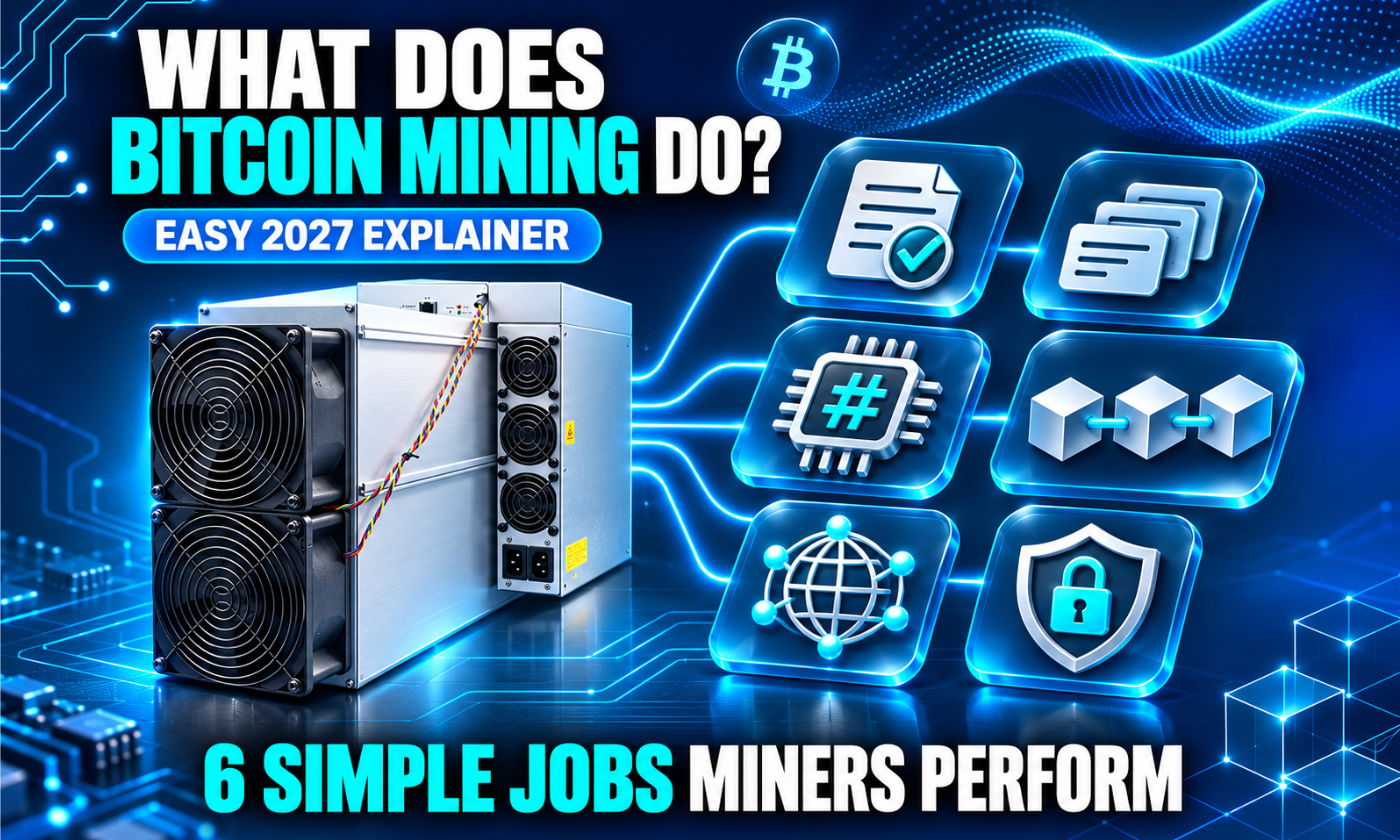
What does Bitcoin mining do? Bitcoin mining does three big things at once: it confirms transactions, it secures the history of every payment against tampering, and it releases new bitcoins into circulation on a fixed schedule. One of the classic Bitcointalk threads asked it bluntly: “So what exactly does mining do for bitcoin?” It has nearly 29,000 views, because once you understand the answer, the rest of Bitcoin makes sense. This guide explains the six jobs miners perform, in plain English, with one real-world example.
What Does Bitcoin Mining Do? The One-Sentence Answer
Miners compete to bundle pending transactions into a block and prove they spent real energy doing it; the winner adds the block to the chain and earns the block reward, which makes rewriting history so expensive that nobody can cheat.
Job 1: Confirming Transactions
When you send Bitcoin, your transaction goes into a waiting area called the mempool. It is not final yet. Miners pick transactions from the mempool, usually the ones paying the highest fee per byte, and put them in the next block. Once your transaction is in a block, it has one confirmation. Each new block on top adds another. Exchanges commonly wait for 3-6 confirmations.
Job 2: Securing the Ledger With Proof of Work
This is the heart of what Bitcoin mining does. To publish a block, a miner must find a number (the nonce) that makes the block’s SHA-256 hash fall below a target. There is no shortcut; the only way is to try trillions of guesses per second. The whole network currently tries about 1,060 quintillion (1,060 EH/s) guesses every second.
Because each block contains the hash of the previous one, changing an old transaction would force an attacker to redo the work for that block and every block after it, faster than the rest of the network. That would require more hardware and electricity than all honest miners combined. This is why proof of work makes Bitcoin’s history practically permanent.
Job 3: Issuing New Bitcoin Fairly
There is no central bank in Bitcoin. New coins appear only as the block subsidy paid to the miner who finds a block, currently 3.125 BTC. The subsidy halves every 210,000 blocks, so issuance is predictable and capped at 21 million. Mining turns electricity into new coins at a fixed, public rate that nobody can change on a whim. Read what happens when all Bitcoin is mined for the long-term view.
Job 4: Ordering Events (Preventing Double Spends)
Digital money has a classic problem: what stops someone from sending the same coin to two people? Mining solves it by putting transactions in a single agreed order. If two conflicting transactions appear, only the one included in the longest valid chain counts. That shared order is what makes Bitcoin money and not just data.
Job 5: Keeping Blocks on a 10-Minute Rhythm
Every 2,016 blocks the network adjusts difficulty so blocks arrive about every 10 minutes, no matter how much hashrate joins or leaves. More miners make it harder; fewer make it easier. Difficulty is near 148 trillion today. See Bitcoin difficulty adjustment explained.
Job 6: Decentralizing Control
Because anyone with an ASIC and electricity can mine, no single company or country controls which transactions get confirmed. The more independent miners there are, including home miners, the harder it is for anyone to censor payments. This is why many people run a small solo miner like a NerdQaxe++ or a heater-style Avalon Q at home.
What Does Bitcoin Mining Do Step by Step? A Real Example
- Alice sends 0.01 BTC to Bob with a fee. The transaction enters the mempool.
- A mining pool builds a candidate block with about 3,000-4,000 transactions, including Alice’s.
- The pool sends work to thousands of miners. Your ASIC hashes the block header with different nonces at, say, 270 TH/s.
- One miner somewhere finds a valid hash. The pool broadcasts the block.
- Nodes around the world check every rule: valid signatures, no double spends, correct reward. If all is fine, they add the block.
- Bob sees one confirmation. The pool splits the reward (3.125 BTC plus fees) among its miners by their share of work.
What Does Bitcoin Mining Do for You as a Miner?
For the person running the hardware, mining is a way to earn Bitcoin directly from the network. Each TH/s earns about 43 sats per day at current difficulty. A modern machine like the Antminer S21 XP earns about 11,600 sats per day before electricity. A home miner like the Avalon Q earns less but also heats a room. Run your numbers on the ROI and Payback Planner.
What Mining Does Not Do
- Miners do not make the rules. Full nodes enforce the rules. A miner that breaks them simply has its block rejected.
- Miners cannot steal coins. They cannot spend coins without the owner’s private key.
- Miners do not “solve math problems” in the school sense. They guess numbers very fast. It is brute force, and that is the point.
FAQ: What Does Bitcoin Mining Do?
What does Bitcoin mining do in simple terms?
It confirms payments, protects the payment history and creates new coins on a fixed schedule.
Why does Bitcoin mining use so much energy?
Energy is the security. The cost to attack Bitcoin equals the cost of out-mining everyone else. Many miners now use stranded or renewable power. See our solar Bitcoin mining guide.
Where can I learn the technical details?
Section 4 of the Bitcoin whitepaper explains proof of work, and our article on cryptographic hash functions covers SHA-256.
The Bottom Line
What does Bitcoin mining do? It turns electricity into security, order and fair issuance, and it pays you for helping. Ready to take part? Start with our beginner mining guide, browse Bitcoin miners, or ask Mine Mirth for a recommendation.